Sunday, October 11, 2015

"Hello Ocean" saving oceans in wildly different ways

Here's an IndieGoGo project that involves a boat and some social media, and they intend not only to facilitate research on ocean acidification but also marine mammal protection. Check it out.


ad

Saturday, October 10, 2015

It lives: the net

A big mass of abandoned fishing gear has to be dealt with in Hawaii. NOAA says they had to deal with 57 tons of debris during this period. While I wouldn't want this to wash up on my beach, I wonder if there ever comes a time when you just let it be, treat it like a new ecosystem?


ad
Ink Squid T Shirt
Ink Squid T Shirt by UberMonkey
View Black T-Shirts online at zazzle

Friday, October 9, 2015

Say it isn't so, on Nemo

These scientists break the news that the film Finding Nemo would very unlikely have ended with his Dad looking for him. Here's another description of the phenomenon in clownfish.

Science Hangout: Why is Clownfish Behavior in Finding Nemo Misleading? from American Scientist on Vimeo.


ad

Thursday, October 8, 2015

Adaaran Select Hudhuranfushi vacation

I first became interested in The Maldives through the Flickr photographer Ahmed Zahid. Check out his Flickr page at that link. I actually use his photoset as my screensaver on my Apple TV.

This short video documents a vacation of a couple in what appears to be Adaaran Select Hudhuranfushi in the Maldives. It shows some interesting views of the walkway, plus some scuba footage of puffers, eels, and Gil.

Maldives Ocean Villa from martin bates on Vimeo.


ad: customizable business card with nice sea pic.

Wednesday, October 7, 2015

Conversation between pearl and oyster

A great thing about this blog is we'll be able to delve into not only scientific exploration of the ocean but also eclectic artistic expressions of appreciation for it. Today's video certainly falls into that category. Leave a comment if you get the meaning behind this interpretive dance piece, or on the artist's vimeo page. But it also contains some really cool footage of intertidal pool creatures.

comhrá a idir an an péarla ‘agus an oisrí from Beatrice Jarvis on Vimeo.


I'd like to see what this "photo sculpture" looks like in real life.
Mako Shark Photo Sculpture
Mako Shark Photo Sculpture by COREY__FORD
Look at Maco Photo Sculptures online at Zazzle.com

Tuesday, October 6, 2015

Hope Spots Indiegogo project

This Indiegogo project includes the following TED Talk by Sylvia Earle about the plight of the oceans. Worth a watch. The project hopes to create hope spots, which are areas of the ocean protected from commercial exploitation. It's certainly a noble cause. One problem however is I'm not exactly sure how well thought-out this particular project is. Exactly what will they be using the money for? I'm glad they have at least brought the issue to our attention.
And here are some stylish napkins for your next nautically-themed party!
Going Ashore 2 Standard Cocktail Napkin
Going Ashore 2 Standard Cocktail Napkin by shelbysemail2
Look at more Going ashore Paper Napkins at zazzle

Monday, October 5, 2015

Irish Conger Eel

Here we see a little European Conger Eel, most like Conger Conger, found by our friends while scuba diving in Ireland. They are reclusive like the moray eel and, according to Wikipedia, have grown to as long as 3 meters, but typically only reach 1.5 m. Any news of aquatic life in the Northern Atlantic is a surprise to me, frankly due to my ignorance: I'm used to only thinking of aquatic life in the tropics.

Sunday, October 4, 2015

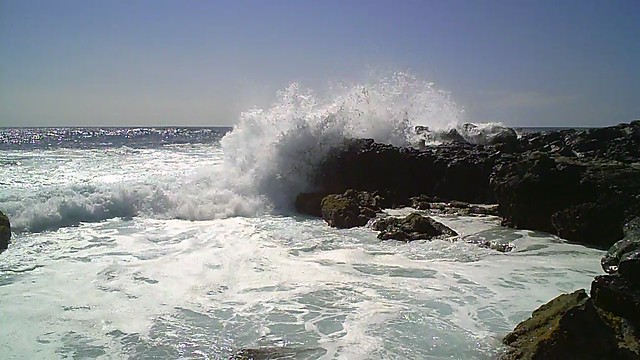
Waves in Hawaii

Ocean Waves at Kaena Point Here is a soothing view of waves breaking on structure that must be of volcanic origin, in Oahu

Saturday, October 3, 2015

FAQ

Why do you mention "open source" videos"?

I looked at one web site that was providing some pretty cool videos about marine life. I wanted to see if I would be allowed to embed their videos in my blog, so I read their license. The license said that the videos were only for "temporary, noncommercial, educational use." What a minefield! If I were to make a blog post, does the "temporary" requirement mean that I have to delete it at some point in the future? If I only store on my hard drive for individual use, exactly when would I have to delete it? As far as "educational", would a blog, celebrating the sea, written by a layperson constitute a sufficiently "educational" purpose? As far as "commercial", would a blog with ads constitute commercial use? Is a blog with no ads (but reference to a for-profit enterprise like Blogger/Google) sufficiently non-commercial? Yikes!

Similarly, a lot of video sites provide embed links to a video. It is my understanding that use of the embed code would be covered under fair use, and furthermore I'm making comment on the videos, and using a link provided by the site that goes back to the author's web page. (IANAL). But suppose there were a professional, scuba-diving videographer, whose sole income was based on his or her videos. How many of these links could I use before I start to take away glory from his or her page at the video site? Would use of embed codes on a site with ads constitute commercial use and ultimately detract from his or her income? Do you think I'm crazy to worry?

Flickr has always billed itself as a "photo sharing" website. Every photo had its own web page, which included a prominent button inviting the visitor to "Blog This!" The current FAQ still says, "Flickr and blogs go together like Captain and Tennille". There was a controversy that erupted about ten years ago where professional photographers objected to their work being spread across the web without their permission. Flickr eventually caved and a staffer clarified that the Blog This button was to be seen as a convenience for those users who had made prior arrangements with the photographer over the conditions of use of their work, not as a blanket permission. I remember someone came up with the solution of "You can always contact the photographer." Oi, vey! I'm imagining that videos posted by companies like National Geographic or the Discover Channel are similarly frought with danger.

That being said, I utterly detest actual piracy. Alex Wild, an entomologist who relies on his award-winning photography for income, has repeatedly complained about pesticide companies that take his photos, cut out watermarks, and even misrepresent the species of the ant. Major uncool.

Is there another way? Suppose you gave up and only made use of video links that you had alicense to use. Fortunately, there is such a thing. There are Creative Commons licenses, such as attribution which explicitly give one the right to:

  • Share — copy and redistribute the material in any medium or format
  • Adapt — remix, transform, and build upon the material
  • for any purpose, even commercially. The licensor cannot revoke these freedoms as long as you follow the license terms.
The web sites archive.org, Flickr, Youtube, and Vimeo have ways to search for creative-commons licensed material. That is largely what I'm using here. I'm also using videos from:
  • Kickstarter is "a new way to fund creative projects." People with all kinds of artistic and humanitarian ideas are able to make public appeals for funding. Some of these videos are quite cool. I cannot imagine that these entrepreneurs would be upset if every blog in the world embedded the videos for their appeals.
  • Advocacy groups While organizations like the Sea Shepherd Society or the World Wildlife Fund have a right to the intellectual property on the creative works they produce, their mission is ultimately one of advocacy. Videos are meant to be seen. If more people see their work, more advocacy is accomplished. It seems unlikely that they'd complain about "excessive fair use" of their work.
  • Government agencies. If the Parks Service prepares a video on how well they are protecting a reef, I doubt they'd be upset if too many people made use of that video. If NOAA prepares an educational video on the data they collect, I imagine they'd be happy if it were widely distributed.